
Postcard from Patagonia
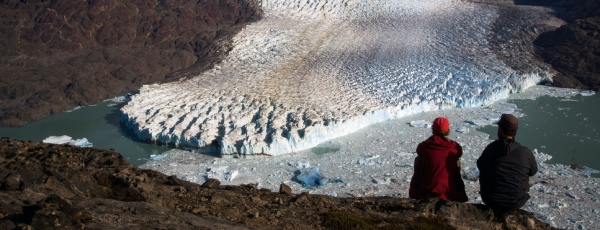
We were delighted to receive an email from Steve Behaeghel and his wife Katrijn, who have just completed an expedition to Patagonia which you can read about on their impressive blog.
While there, they took pictures for Project Pressure and collected samples for other initiatives through Adventurers and Scientists for Conservation – an NGO which links explorers and adventurers with initiatives like ours which can benefit from contributions by the public.
“We spent the last four months exploring remote corners of Patagonia,” writes Steve, whose image shows “the Glaciar O’Higgins, which calves in the huge Lago O’Higgins from the Southern Patagonian Ice Cap. This viewpoint is reached by a remote trek in the southern tip of the Aysen region, in Chilean Patagonia. Only a few determined people a year reach this remote rocky outcrop mirador per year.”
“The first night we scrambled up in very windy weather to find the 60m high (sticking out of the water) 3km wide glacier without any icebergs. After a stormy night, and now with windstill, sunny conditions, we hiked up again, to be astonished with the view that a huge shelf at least one mile long that had calved off during the night – forming a huge amount of ice and bergs in the lake.”
“We’re heading into the Cordillera Blanca and Huayhuash the upcoming seven weeks, with a lot of data collecting in the pipeline. Saludos from Huaraz, Peru.”
–Steve and Katrijn, Patagonian Dreams
Oxford Internet Institute blog
Following his Project Pressure talk, Klaus Thymann spoke to the Oxford Internet Institute’s David Sutcliffe about glaciers, data and crowdsourcing in detail. You can read more on the Institute’s Policy and Internet Blog.
Colombia & Bolivia expedition confirmed
Just confirmed our latest expedition – in June, Project Pressure will team up with Jorge Luis Ceballos of IDEAM to visit glaciers in the Sierra Nevada del Cocuy in Colombia, and then travel to Bolivia to document the Cordillera Real range.
Black Ice – mini feature
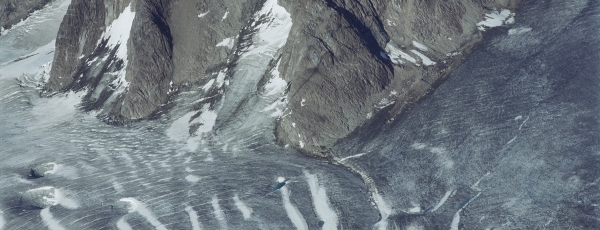
Project Pressure’s recent expedition to Eastern Greenland gave us an aerial view of one of the most insidious problems in the fight against climate change: darkening ice.
As a look through our photographic gallery reveals, glaciers are often naturally dirtied and darkened, especially during the summer months when no new snow accumulates– but over time, small manmade particles can also land and make them darker. The result is that less sunlight is reflected, more solar energy is absorbed and more melting takes place: a dangerous feedback loop that could become a key tipping point as the world warms.
The problem is especially pronounced in the Arctic and in the Himalayas, where a combination of emissions from transport, cooking stoves, wildfires, land clearance, coal power plants other sources drifts north over the ice and snow. Though tiny, these black carbon particles are collectively a serious problem – reducing the reflectivity (or ‘albedo’) of vast white surfaces and so causing significant melting.
The good news is that black carbon also presents a serious opportunity to reduce overall warming and improve people’s health. Firstly, it’s responsible for as much as 25% of observed global warming* – so tackling such emissions could bring serious results. Secondly, it doesn’t last long in the atmosphere (generally settling after just a few weeks) so the effects of a reduction would soon kick in. Thirdly, reducing these toxic pollutants would have huge benefits for human health, meaning it’s not just an environmental issue.
In the Western world, diesel emissions have been sharply reduced – benefitting both people and the planet. As shipping increases with the retreat of Arctic ice, limiting these dark emissions will remain a challenge – but one with serious potential to limit climate change.
Text by Chris Hatherill for Project Pressure
* J. Hansen, et al., Efficacy of Climate Forcing, 110 J. GEOPHYS. RES. D18104, 1 (2005), available at http://pubs.giss.nasa.gov/docs/2005/2005_Hansen_etal_2.pdf.
Oxford Institute lecture
Project Pressure photographer and founder Klaus Thymann spoke recently at the Oxford Internet Institute event “Changing Behaviour: Participation, Influence and Impact” – alongside the BBC’s Holly Goodier and technology journalist Aleks Krotoski. His talk gives a good overview of the project and our interactive online platform, MELT.
Darran Mountains, New Zealand
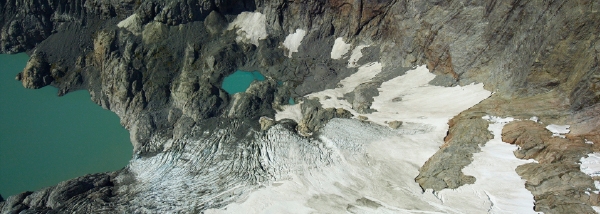
Project Pressure photographer Klaus Thymann recently returned from our first expedition to New Zealand, where he photographed and data-logged glaciers in the Darran Mountains of Fiordland National Park (pictured). Working with glaciologist Dr Trevor Chinn, the team travelled by helicopter to enable them to visit Mount Tutoko, Mount Madeline, Mount Gunn and Mount Prembroke. This is one of the few places in the world where lush temperate rainforest and glacier-covered peaks exists in such close proximity, and we’ll bring you more photographs as soon as they’re processed and graded.
Photo gallery in House Magazine
Images from Project Pressure are featured in the glossy section of latest issue of [i]House[/i] – the magazine for Soho House members worldwide. You can read it online (article is on page 36).
Project Pressure featured in DAMn°
An Inventory of Norwegian Glaciers
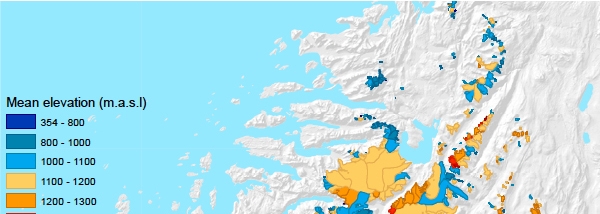
The recently published Inventory of Norwegian Glaciers features a number of Project Pressure images gathered during a combined field trip with editors/authors Liss Andreassen and Solvieg Winsvold. You can download a copy of this excellent report here.
2013 expeditions
Project Pressure is currently planning expeditions next year to document glaciers in Colombia, Bolivia, Svalbard and New Zealand. We’re also expanding our social media coverage, so you can now follow all the action via Twitter and Facebook.